Will Python Remain Essential as AI Tools Become Smarter?
I am a Business Growth Strategist at a Leading Software Development Company. I have experience in developing and executing digital strategies for large global brands in a variety of business verticals. Apart from working on a long-lasting relationship with customers and boost business revenue, I am also interested in sharing my knowledge on various technologies and their influence on businesses through effective blog posts and article writing.
Artificial intelligence is changing how developers write code, solve technical problems, and build software applications. AI-powered coding assistants can now generate functions, identify errors, explain unfamiliar programs, and suggest improvements within seconds. As these tools become more capable, an important question is gaining attention: Will programming languages like Python remain necessary when artificial intelligence can write code on its own?
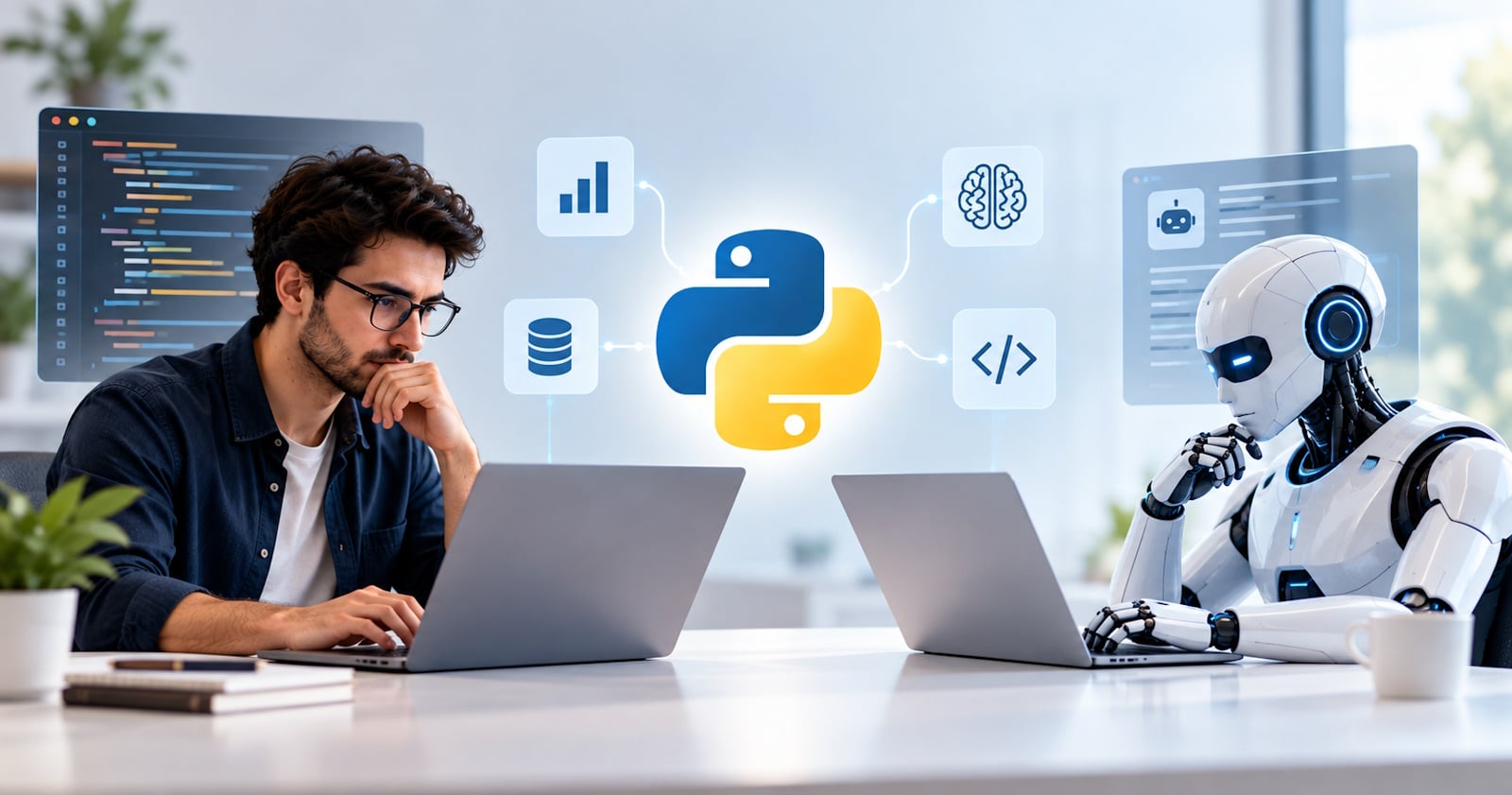
Python has played a major role in the growth of machine learning, data science, and AI applications. Its simple syntax, extensive libraries, and strong developer community have made it a preferred language for researchers and software engineers. While AI tools are changing programming workflows, they are not eliminating the need for reliable programming languages. Instead, Python's role is shifting as developers learn to combine traditional software engineering with increasingly capable AI systems.
Why Python Became So Important to Artificial Intelligence
Python's popularity in artificial intelligence developed long before generative AI became widely accessible. Researchers and engineers adopted the language because it allowed them to experiment with mathematical models, process datasets, and develop algorithms without dealing with unnecessarily complicated syntax.
Libraries such as NumPy, pandas, and scikit-learn made Python useful for numerical computing, data analysis, and machine learning. Frameworks including PyTorch and TensorFlow expanded its capabilities into deep learning, supporting applications involving image recognition, natural language processing, and predictive modeling.
Python also became popular because researchers could share code, reproduce experiments, and collaborate through open-source projects. This established ecosystem remains valuable even as AI-assisted programming tools become more advanced.
Rather than replacing Python, many modern AI technologies continue to depend on Python-based frameworks and development environments.
AI Coding Assistants Are Changing How Python Is Written
One of the most visible changes in software development is the growing use of AI coding assistants. Tools such as GitHub Copilot and ChatGPT can generate Python scripts, suggest debugging approaches, and explain unfamiliar programming concepts.
A developer can describe a task in natural language and receive a working code example within seconds. For repetitive activities such as preparing data, writing basic API endpoints, or creating unit tests, this can reduce the amount of manual coding required.
Yet generated code is not automatically correct or suitable for production environments. AI assistants may misunderstand requirements, introduce security weaknesses, or suggest outdated library functions.
Developers must still evaluate the generated output, test its behavior, and confirm that it works within the larger application. AI can reduce the effort involved in writing code, but it does not remove the need to understand what that code actually does.
Python Remains Important Behind AI Applications
Although AI assistants can generate programming code, the applications using these assistants still require software infrastructure. Python continues to provide tools for connecting AI models with databases, external services, and business applications.
For example, a company developing an AI-powered customer support system may use Python to retrieve information from internal documents, communicate with a language model, process responses, and manage application workflows.
Frameworks such as FastAPI and Django support the development of backend services that connect AI capabilities with websites, mobile applications, and enterprise platforms.
Businesses exploring Python Development Services can use these capabilities to build applications involving automation, data processing, and AI-powered features. Successful projects require more than model access. They also depend on security, system reliability, application testing, and ongoing maintenance.
As AI becomes part of more business processes, the supporting software remains just as important as the models themselves.
Smarter AI Tools May Change Python Developers' Responsibilities
AI-powered development tools are gradually changing what programmers spend their time doing. Activities involving repetitive code generation, basic debugging, and documentation can increasingly be supported by automated assistants.
This may allow developers to concentrate on software architecture, system design, security, and complex problem-solving. Instead of writing every function manually, programmers may spend more time reviewing generated solutions and deciding how different components should work together.
These responsibilities require a strong understanding of programming fundamentals. Developers must recognize when AI-generated code is incorrect, unnecessarily complicated, or unsuitable for a particular application.
Python professionals who understand databases, APIs, testing frameworks, and cloud infrastructure will continue to bring important technical knowledge to software projects.
The ability to work effectively with AI assistants is becoming useful, but it complements programming expertise rather than replacing it.
Why AI Cannot Completely Replace Programming Knowledge
Generating code and understanding software behavior are different activities. AI assistants can produce convincing solutions, but they do not automatically understand every business requirement, operational constraint, or security risk associated with a project.
Consider a healthcare application that processes sensitive patient information. An AI assistant might generate Python code for handling records, but developers must still verify access controls, data protection requirements, and system behavior under unexpected conditions.
Complex software projects also involve architectural decisions that affect performance, maintenance, and future development. Choosing database structures, managing dependencies, and designing fault-tolerant systems require careful evaluation.
Even when AI tools become better at generating code, organizations will still need people who can assess whether applications meet their intended requirements.
Programming knowledge provides the foundation for making those judgments and identifying problems before they affect users.
Python's Role in Data Science and Machine Learning
Python's relevance extends beyond writing conventional software applications. It remains deeply connected to data science, statistical computing, and machine learning research.
Data scientists use Python to clean datasets, examine patterns, train models, and evaluate predictions. Libraries such as pandas and scikit-learn support these activities, while visualization tools help researchers interpret results.
AI assistants can help generate analytical scripts, but they cannot guarantee that datasets are accurate or that statistical conclusions are appropriate.
Professionals must still understand data quality, model evaluation, sampling methods, and the limitations of their analytical approaches.
As organizations collect more information and explore predictive applications, Python's established data science ecosystem is likely to remain useful. Its value comes not only from writing algorithms but also from supporting the broader process of turning information into meaningful analysis.
Will Businesses Still Need Skilled Python Developers?
The availability of AI coding tools may encourage organizations to reconsider how they structure development teams. Some routine programming activities may require less manual effort, but complex applications continue to demand experienced technical professionals.
Businesses need developers who can translate requirements into working systems, evaluate architectural choices, protect sensitive information, and maintain applications after deployment.
Companies planning software projects may choose to Hire Python Developers with experience in backend frameworks, cloud platforms, automation, and AI-related technologies. The required skills depend on the project's technical complexity and business objectives.
Developers who understand how to use AI tools responsibly may also help teams reduce repetitive work while maintaining software quality.
The demand for particular programming tasks may change, but the need for dependable software engineering remains.
Could Another Language Replace Python in AI Development?
Python is not the only programming language used in artificial intelligence. C++, Rust, Java, Julia, and other languages support different aspects of AI infrastructure and application development.
Performance-sensitive systems may use compiled languages for computationally demanding operations. Embedded AI applications may require technologies designed for limited hardware resources, while large enterprise platforms may combine several programming languages.
Python itself often relies on underlying components written in C, C++, or specialized GPU programming technologies. This allows developers to work with a readable programming interface while computationally intensive operations execute through faster components.
As AI systems become more sophisticated, organizations may adopt additional languages for specialized requirements.
This does not necessarily reduce Python's relevance. It reflects the reality that complex software systems benefit from selecting technologies according to their specific strengths.
What Python Developers Should Focus on Next
Developers preparing for an AI-assisted future should continue strengthening their programming fundamentals while becoming familiar with modern AI development tools.
Understanding Python syntax remains important, but professional growth also requires knowledge of application architecture, testing, databases, cybersecurity, and deployment practices.
Experience with AI model APIs, data pipelines, retrieval-based applications, and model evaluation can provide additional opportunities. Developers should also learn how to review AI-generated code critically rather than accepting suggestions without verification.
Building practical projects remains one of the best ways to develop these skills. Working through real application requirements exposes challenges that automatically generated examples may not fully address.
The goal is not to compete with AI at producing routine code. It is to develop the technical judgment needed to build software that works reliably.
Python's Future Is About More Than Writing Code
As artificial intelligence becomes more capable, the way developers interact with programming languages will continue to change. Natural language instructions may handle more routine coding activities, and AI assistants may become increasingly involved in testing and software maintenance.
Yet applications will still require dependable code, clear system architecture, secure data handling, and ongoing technical supervision. Python's established ecosystem makes it well suited to remain part of these processes.
Its future importance will depend less on how many lines of code developers write manually and more on how effectively the language supports useful applications.
AI may change the experience of programming, but it does not make programming knowledge irrelevant. Python is likely to remain an important technology because it connects artificial intelligence with the practical software systems that businesses and individuals depend on.